Dissertation Writing 101 – Your Complete Dissertation Mastery Guide For 2025
Is even the thought of writing a dissertation nerve-wrecking for you? You are not alone. According to a report by ResearchGate, 80% of students...
Is even the thought of writing a dissertation nerve-wrecking for you? You are not alone. According to a report by ResearchGate, 80% of students...

Is even the thought of writing a dissertation nerve-wrecking for you? You are not alone. According to a report by ResearchGate, 80% of students feel anxiety while writing their academic documents. However, writing a dissertation is one of the most rewarding academic tasks, and it plays a crucial role in shaping your academic career.
Therefore, you must write a well-structured and research-based dissertation, which helps you earn higher academic grades. Are you wondering how to write a dissertation step-by-step? We have got you covered. In this blog, The Academic Papers UK experts will share comprehensive guidelines for writing a winning thesis.
Before moving on to the writing process, you must know the key elements to structure a perfect thesis in 2025. Let’s explore them in the next section.
A dissertation is a lengthy piece of academic writing that explores a new angle in the relevant study. It is an important milestone that students have to achieve to earn an undergraduate and postgraduate degree successfully. No matter which degree program you are writing this document for, you must write a well-structured thesis by adding all the essential elements.
Have a look at what these elements are.

It is the first section of your dissertation. This page contains your research topic, your name, and the name of your department. Additionally, you must add your institution name, degree/program, and submission date. It also includes your student ID, the supervisor's name, along your university’s logo.
Let us help by creating an original paper from scratch
An acknowledgement is the only section in which you write in the first-person pronoun. On this page, you have to thank everyone who helped you in your custom dissertation writing journey. You can thank your supervisor, family, friend, or any individual who participated in your research. In short, in this section, you get the opportunity to thank all the people who supported you academically or personally.
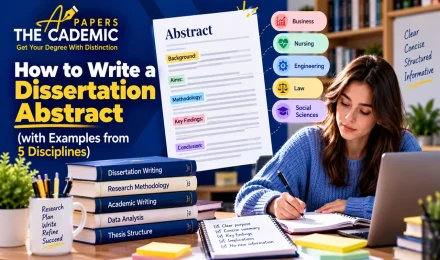
It is a summary of a dissertation that is approximately 150-300 words in length. You should write this part once you have completed your research work. Below are some of the most important things that you must add while writing this section, including:
Thus, you should write this part with the utmost care, as it is the first part of the research that people read.
It is another important element of your dissertation. This section includes a list of all the chapters’ names, headings, and subheadings. All these headings and subheadings must be added with page numbers. The primary purpose of this page is to help the reader determine the dissertation’s structure.
Apart from this, this page helps the reader navigate the whole research work. So, you should add all parts of your research work, including references, to the table of contents. Further, you can add this section of the study either manually or automatically.
If your research work includes any figures and tables, then a numbered list will help you in this regard. This section will not only enhance your readers’ understanding but also improve the credibility of your research work.
There are areas of study in which research work includes a lot of abbreviations. If your work contains a lot of abbreviations, you should include a list of them. You should add them to the list in alphabetical order. It will help the reader in easily looking for their meanings.


AI lacks the depth your degree requires. Our human experts deliver tailored research and authentic academic insights.
Consult with an Expert, It's freeA dissertation always contains a lot of highly specialised terms, which are essential to add to maintain its quality. Therefore, if your work contains specialised terms, then you should add a glossary section. In this section, you can briefly explain each term while alphabetically listing them.
The introduction is usually the first chapter that your readers explore in your dissertation. This chapter starts with the research topic and its purpose. Moreover, you must explain the relevance of research in the area of your research study. Apart from this, you should also highlight what makes this research work better than previous research.
There are a few more things you should add while writing a dissertation introduction, including:
Additionally, the introduction part of any dissertation consists of 10% of the whole word count. Let’s suppose that if you are writing a 10,000-word dissertation, then your introduction will be 1000 words. In these 1000 words, you will discuss the points mentioned above. It is essential to write a clear introduction to build relevance, keep your audience engaged, and achieve your research objectives.
The literature review section of the dissertation usually discusses existing research work. You should ensure that it is related to the research work. In addition, this section of your dissertation focuses on the following things:
Furthermore, this section of your master’s dissertation consists of 30% of the total word count. In this word count, you can discuss key theories and models that frame your research. If you find it hard to write this section within the given word count, you can seek master’s dissertation help from our seasoned writers, who can guide you at every stage of the writing process, from topic selection to formatting the paper.
The methodology section gives you space to explain how you have conducted the whole research. Moreover, this chapter aims to empower the readers to check the validity of their research work. This chapter of your dissertation includes the following things:
Additionally, in this section, you must explain how your research objectives align with your chosen experimental method. This chapter contains 15% of the total word count of your dissertation.
The next section of a dissertation is the results section, where you present your research results. You can divide this section into sub-questions and hypotheses. However, it is important to discuss only those results that are relevant to your research. The way of data presentation depends on the type of method you have used for your research.
For instance, in qualitative research, data is presented along with analysis. But in quantitative research, this section is a separate portion of the study. Additionally, it is also helpful if you present your research section with the help of graphs and tables. However, you should refrain from repeating things in this section. This section of a study consists of 5% of the whole dissertation’s word count.
Discussion is one of the most important chapters of your dissertation, which outlines an explanation of the implications of research results. In this section, you must interpret your results in detail to tell the readers the significance of your research. This section includes the following key factors:
This section is very similar to the discussion chapter, and many students are confused about how to write a dissertation conclusion or what it comprises. This section of the thesis should answer your main research question. In this chapter, you must conclude your research work, which helps the reader to understand the central argument of your research.
Additionally, in the concluding chapter, you convey to your reader what you did in the research and how it was made possible. The conclusion of a dissertation consists of 10% of the entire word count of the dissertation. It means that if you write an 8,000-word dissertation, this section will comprise only 800 words.
At the end of your dissertation, you should provide a complete list of sources from which you have gathered the information for your research work. Apart from adding references to the bibliography, you should provide in-text citations to justify your point.
However, while adding the reference list, you must ensure that you have followed the right reference style. For this, you must explore the guidelines provided by your institution, as each university has its specific formatting requirements. Your research advisor can guide you better on how to reference your sources. Besides, you can also use a citation generator to correctly cite your references within the list.
Sometimes, you need to add some information to your dissertation which is not directly related to your research work but essential for your readers’ understanding. You can add this information in a separate section of your dissertation named as appendices. Examples of these documents include interviews and surveys. You can add these parts within the appendices section.
As you have learned about the structure of the dissertation, now it’s time to move on to the writing steps that can make your dissertation writing journey a piece of cake.
A dissertation is the longest and most challenging task that students have to complete during their academic career. Writing this document can be a smoother journey if you know the writing steps. Below are the key steps that you must follow while writing a dissertation without losing your mind.

The dissertation writing process starts with choosing a topic. This step sounds like an easy step, but it significantly helps you in writing a winning dissertation. In some fields, the supervisor provides a topic on which students have to write a dissertation. In most cases, students need to pick a topic by themselves.
If your dissertation advisor also asks you to select a topic yourself, you must take into account the following characteristics in it.
Let us help by creating an original paper from scratch
Once you have selected your research topic, it’s time to do some preliminary research to hone your topic. This research will provide you with an overview of your topic and its current state in your research field. Additionally, it will make sure that there is enough information available on your selected topic.
Follow the tips below while conducting this initial research for your topic.
Generally, for advanced dissertations, students have to write a research proposal to get permission from their advisor and the university to conduct the research on the selected topic. The length and format of this paper depend on your field. In most cases, this proposal consists of 10-15 pages comprising a detailed discussion on your topic, methodology, and the secondary research.
The paper may be accepted or rejected by your dissertation advisor after evaluating it with specified merits. Below are the key things that a research proposal must entail:

When your dissertation advisor approves your topic, it’s the right time to conduct the principal research on your topic. The key purpose of this research is to gather the information to answer your research query and achieve your aims and objectives behind this research.
Follow the steps below to conduct primary research for your dissertation.
It is one of the most important steps of dissertation writing, which enables you to structure your document well. Although this outline is the unofficial part of your dissertation, it plays a significant role in organising your document. A good outline of your thesis includes the core ideas, themes, and evidence that you intend to add in each chapter of your dissertation.
You must take into account the following tips while outlining your dissertation.
Writing a dissertation is a long haul, as it can take weeks, months, or even years to complete your dissertation. It is good to start writing your dissertation as soon as possible. So, if you have made your dissertation’s outline, start writing the first draft of your thesis.
Many students stare blankly at the page as they are afraid to write a perfect first draft of their dissertation. Nonetheless, it is not possible to write a flawless document on the first attempt. At this step, you just have to flesh out your ideas without worrying about being perfect. Just make sure that you write it in a simple language and elaborate ideas point by point.
Many students are stuck on writing the introduction of their dissertation as they don’t know how to write an engaging opening of their theses. Likewise, writing the conclusion of the dissertation is also challenging for them. To ensure the successful completion of their dissertation, they can buy dissertations online from our professional writers.
So, you have written the first draft of your dissertation. Congratulations. You have completed the crucial step of the monumental process. The next thing that you must do is to seek feedback on this first draft. The first person from whom you must ask for feedback is your supervisor, who is there to assist you throughout the writing process. For this, you must send a copy of your first draft to your advisor and ask him/her to take a look.
This feedback is important in identifying the problematic areas and giving a new direction to your research. Apart from the advisor, you could send the first draft of your thesis to your field specialists and get their valuable feedback. You can also ask our professionals to provide PhD dissertation help to get valuable feedback for polishing your academic document.
As you have received the feedback from your supervisor and our expert writers, you now have a clear understanding of what changes you must make in your first draft. It’s time to incorporate all these improvements and changes and finalise your dissertation.
During the writing of the final draft of your thesis, you will explore the following things:
The last thing that you must do before submitting your dissertation is to edit and proofread your dissertation. This step is important to polish your research document and remove spelling mistakes, grammatical errors, and structural flaws. Therefore, you must proofread your dissertation carefully before submitting it.
To effectively proofread your document, you must follow the tips below:
The duration of dissertation writing depends on the complexity of your research project, subject matter, and work habits. In general, PhD students take one to several years after completing their coursework to write their dissertation. During this time, they have developed research questions, conducted literature reviews, crafted research strategies, collected data, and written their dissertations.
On the other hand, for a master’s dissertation, this time period gets shorter by around one to two years. Most students complete their dissertations during this shorter time. However, some struggle to write their theses within the set deadline. They can seek help from our dissertation helpers and ensure the successful completion of their dissertations.
Writing a dissertation is an important academic task that students have to complete to earn a higher educational degree. However, most students feel overwhelmed while writing this research document as they don’t know what strategic approach they must follow for this writing process.
To aid them, we have shared a step-by-step guide for writing a dissertation successfully. These steps include selecting a topic, conducting preliminary research, writing a research proposal, doing primary research, outlining a dissertation, writing the first draft, seeking feedback, finalising the dissertation, and proofreading.
We hope that by following these steps, you will be able to craft a winning dissertation for your subject matter. If you are still in confusion, you can avail of dissertation writing services UK from our British writers and ensure the successful completion of your thesis. So, don’t waste your time, reach us now.

If you want to cite this source, you can copy and paste the citation or click the Cite this article button to automatically add the citation to our free Citation Generator.
Julie Shearer (September 29, 2021). Dissertation Writing 101 – Your Complete Dissertation Mastery Guide For 2025 Retrieved October 9, 2026, from https://www.theacademicpapers.co.uk/blog/2021/09/29/dissertation-writing-101-a-complete-guide/
 Table of Contents


Share your requirement, expected grade, and an expert will be by your side in no time.
Yes, I want an A+