How To Develop An Engaging Rhetorical Analysis Essay Outline? Tips With Examples
This blog helps you discover a comprehensive guide on developing an outline for your rhetorical analysis essay writing, along with expert tips and examples....
This blog helps you discover a comprehensive guide on developing an outline for your rhetorical analysis essay writing, along with expert tips and examples....

This blog helps you discover a comprehensive guide on developing an outline for your rhetorical analysis essay writing, along with expert tips and examples. So, read it till the end to explore this journey together!
In a rhetorical analysis essay, you need to understand and deeply analyse the context of the author like what he wants to convey to the audience.
According to Miami University, the primary purpose of rhetorical analysis is to examine the use of language to achieve a specific goal. It involves the study and analysis of the context of the communication designed by an author like the aim, audience, and medium.
As a beginner, you may have no idea about the analysis of the rhetorical strategies of the author. To assist you in this regard, the expert writers at The Academic Papers UK have composed a complete guide laced with expert tips and examples on how to design an effective rhetorical analysis essay outline to write it excellently.
Keep reading for a better understanding!
Wondering how to develop an engaging rhetorical analysis essay outline to write it well? Don't worry; we will assist you in creating a well-defined outline that will not only help you organise your ideas but also ensure your success in such essays. However, if you still need support to do this task perfectly, you can seek help from the best UK-based essay writers.
However, the following are a few detailed tips to help you craft an outstanding rhetorical analysis essay outline.
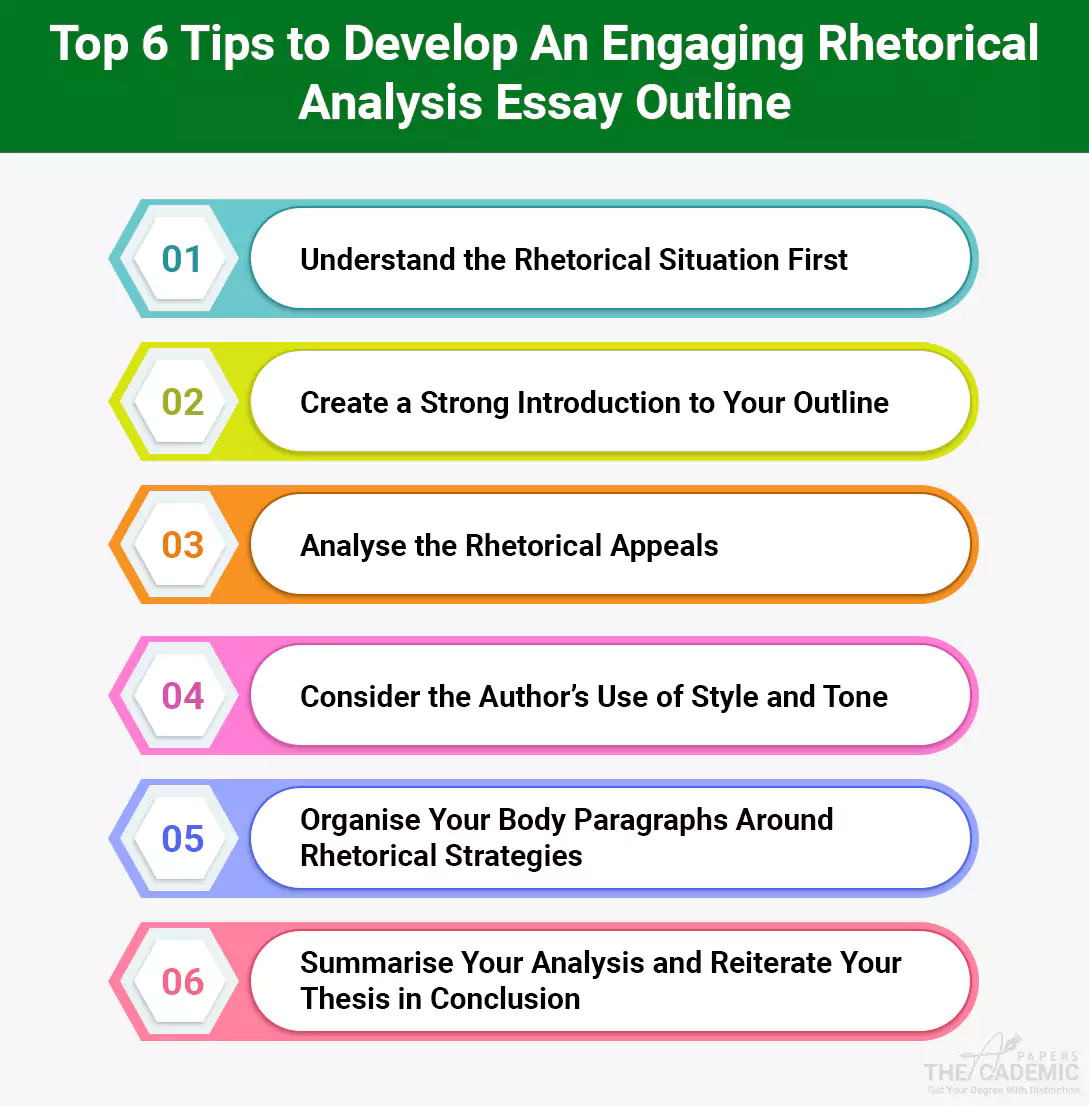
It is crucial to understand the rhetorical position of the text before you begin to create your outline. Everything relevant to the essay, such as the author's intention, the reading audience for which it is written, the medium, and the context of the work, are all included in the rhetorical situation.
The following are a few important components to analyse here:
Your research will more effectively concentrate on how the author modifies their writing to affect the target audience if you have a solid understanding of the rhetorical context while designing a rhetorical analysis essay outline.
Get expert help organising your claims, evidence, and analysis.
The key component of your rhetorical analysis essay begins in the introduction. In your introduction, introduce the text you are investigating, note its rhetorical position, and present your thesis. You also need to get rid of all the misconceptions you have related to the introduction of the essay.
The following are key components of an introduction:
In this story, the author challenges preconceptions and encourages her audience to acknowledge the complexity of cultural identity through personal tales, pathos, and ethos.
The basis for the rhetorical analysis of the essay lies in your evaluation of the author's use of ethos, pathos, and logos. In your rhetorical analysis essay outline, set apart particular passages for each of these arguments and explain how they add to the text's general strength.
According to California State University, the following are examples of typical rhetorical analysis essays:

Image Source: California State University
Indeed, it is a crucial part of your rhetorical study to evaluate the author's writing style and context while designing an engaging rhetorical analysis essay outline. These elements are essential as the audience will understand and absorb the content. You must also understand how to critically reflect in essay writing to ensure success in these academic projects.


AI lacks the depth your degree requires. Our human experts deliver tailored research and authentic academic insights.
Consult with an Expert, It's freeAdichie employs a conversational tone in The Danger of a Single Story, which makes the speech more approachable and relatable and aids in establishing a relationship with her audience.
While writing a body paragraph of a rhetorical analysis essay, every paragraph should focus on one particular rhetorical method. The secret to a well-structured analysis is to divide the text into small sections, each making a unique argument on the rhetorical tool. To effectively organise the body content, you need a proper essay plan from the beginning to the end.
This is how you can organise your body paragraphs to create a compelling rhetorical analysis essay outline.:
After reviewing the author's rhetorical methods, you can freshly restate your thesis and provide a summary of the key ideas of your rhetorical analysis. If you don't understand how to do it, you can use ChatGPT for essay writing, but this also allows you to consider the larger relevance of the author's message and the effects of the rhetorical decisions on the readers.
The following are the three important elements of a conclusion that you must keep in mind while creating a rhetorical analysis essay outline:
Before starting work on your rhetorical analysis essay, finding, understanding, and analysing some of the previously well-performing relevant studies is crucial. For this purpose, you may go through the examples of essays to get an idea about how to create an outline and proceed toward effective writing. Here are a few examples that you can consider for writing your rhetorical analysis essay.
The first example is from Academia providing a detailed outline for writing rhetorical analysis essays effectively, such as:

Image Source: Academia
St. Louis Community College provides a sample essay on rhetorical analysis to assist students in understanding how to write it well.

Image Source: St. Louis Community College
Pro Tip: While creating your rhetorical analysis essay outline, draft a few sample paragraphs to see how each rhetorical strategy supports the author’s message. You can also hire our experts to write your essay so that every section is well-structured and compelling.
We all know the importance of an engaging rhetorical analysis essay outline for writing an essay as it provides a clear roadmap for the reader. You can write your essay outline excellently by understanding the author’s message and its main purpose. To help you develop an outline, we have included a detailed guide with expert tips and examples here.
Additionally, struggling students working on their analytical projects can also streamline their workflow by getting essay writing services from The Academic Papers UK. So, by using both online support and following our expert's tips, you can focus on all the crucial elements of a rhetorical analysis essay. Make your writing process easier and ensure success in creating essays by developing an engaging outline.

If you want to cite this source, you can copy and paste the citation or click the Cite this article button to automatically add the citation to our free Citation Generator.
Kimberly Johnson (January 31, 2025). How To Develop An Engaging Rhetorical Analysis Essay Outline? Tips With Examples Retrieved October 21, 2026, from https://www.theacademicpapers.co.uk/blog/2025/01/31/how-to-develop-an-engaging-rhetorical-analysis-essay-outline-tips-with-examples/
 Table of Contents


Share your requirement, expected grade, and an expert will be by your side in no time.
Yes, I want an A+