How to Write a Research Hypothesis (with Examples)
Key Takeaways A hypothesis is a testable prediction about differences, influences, and relationships among variables. The difference between a research question and a hypothesis...
Key Takeaways A hypothesis is a testable prediction about differences, influences, and relationships among variables. The difference between a research question and a hypothesis...

A research hypothesis is a specific, testable prediction about what you expect to find in your study. It states how two or more measurable variables connect, drawing directly from existing theory or prior empirical research. Rather than asking an open question, a hypothesis makes an educated, directional or non-directional guess about the outcome.
If you are a student writing an undergraduate or postgraduate dissertation at a UK university, understanding how to write a hypothesis is essential for any quantitative project. It provides the foundation for your data collection, your choice of statistical tests, and your final discussion.
This step-by-step guide by The Academic Papers UK breaks down everything you need to know: from distinguishing research questions from hypotheses to choosing the right statistical tests and avoiding common pitfalls.
Get help to translate your research question into a clear, testable prediction.
Every empirical dissertation starts with a broad issue, but students frequently confuse the research question with the hypothesis. Answering the core question directly: A research question asks an open-ended inquiry about an academic problem, whereas a hypothesis provides a tentative, testable answer to that question. The research question is what you want to explore, and the hypothesis is what you think will be the relationship, difference, or effect between the variables. Considering this, the following table provides you with a clear understanding of their differences.
| Feature | Research Question | Hypothesis |
| Form | Written as a question | Written as a prediction |
| When Used | Early-stage or exploratory research | Quantitative studies with measurable variables |
| Research Approach | Often inductive | Both inductive and deductive |
| Role in Analysis | Organises chapters, defines the topic, and guides how to write aims and objectives. | Directs inferential statistical testing (e.g., t-tests, regressions, ANOVA). |
| Example | Does social media use affect academic performance? | Students with higher social media use will have lower academic performance. |
In almost all cases, no. Qualitative dissertations (using interviews, focus groups, thematic analysis, or phenomenology) rely on an inductive research logic. Inductive research explores lived human experiences, meanings, and social contexts without prejudging what the data will reveal. Imposing a fixed hypothesis before gathering open-ended qualitative data restricts exploratory findings and contradicts qualitative methodology.
If you are conducting a qualitative project, focus your efforts on developing 1 to 3 robust research questions and linked sub-questions instead of constructing statistical hypotheses.
A research hypothesis can be written by applying 6 steps. These steps include;
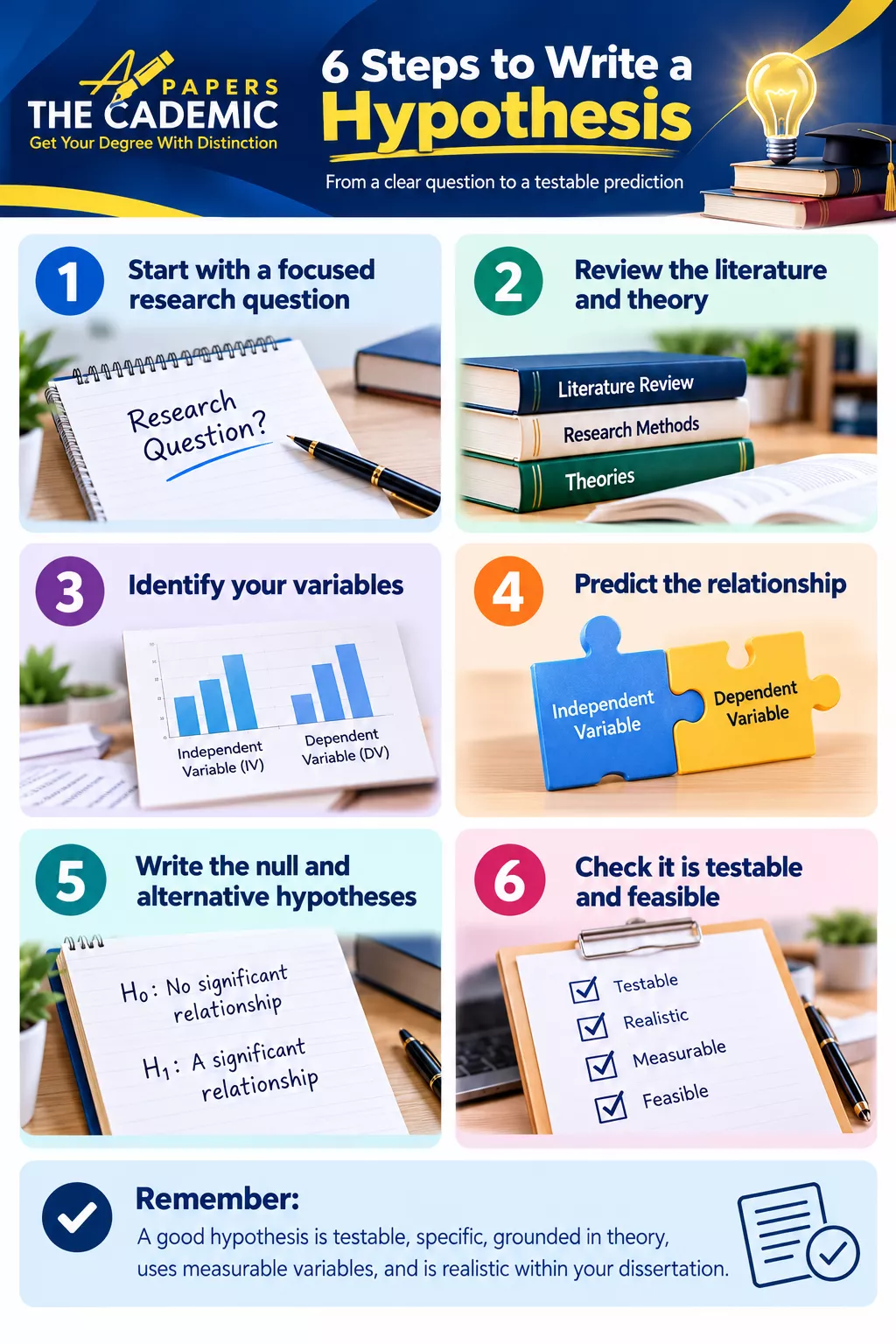
Start with a question that helps you determine what you will be studying. For instance: “Does studying time impact the scores of the students at the undergraduate level?”
It is necessary to understand that your research hypothesis should be based on this question.
A research hypothesis cannot be an arbitrary personal guess. You must perform an extensive literature review and research on established educational theories to support your expectation. In this case, educational learning theories (such as Carroll’s Model of School Learning) propose that academic achievement is directly related to time spent actively engaged in learning tasks. Empirical higher-education literature consistently demonstrates that focused revision hours correlate positively with academic performance.


AI lacks the depth your degree requires. Our human experts deliver tailored research and authentic academic insights.
Consult with an Expert, It's freeVariables are key factors, quantities, or characteristics that can change or influence others. While writing a hypothesis for a dissertation, you should identify these variables so that you can test their relationship.
Break your core construct down into operational, measurable components:
Determine whether prior academic literature supports a specific direction (e.g., higher/lower) or if conflicting findings justify only predicting a non-directional relationship. Because extensive educational research links increased study time with improved academic attainment, a directional relationship is justified.
The null hypothesis and alternative hypothesis are two complementary statements of the hypothesis that are statistically tested (which will be explained in detail later in the guide). Formulate both predictions using formal academic phrasing:
Ensure that your variables produce data that match your planned analytical test. Here, measuring two continuous numerical variables across the same student cohort (hours studied per week and examination score out of 100) indicates that a correlation or regression might be the appropriate statistical method (which is suitable? It’s yours to find!).
Introductory science classes often teach the basic format:
"If undergraduate students spend more time studying, then their test scores will increase."
While this conditional structure demonstrates basic cause-and-effect, it appears simplistic in university-level dissertations. At undergraduate and postgraduate levels, write in clear declarative statements that explicitly embed your measurable variables:
H0, or the null hypothesis, means that there is no significant difference, association, or effect. On the other hand, H1 means that there is a difference, association or effect. According to National University Statistics Resources, in the case of statistical tests, the researchers will evaluate the evidence against H0. They tend to reject H0 if evidence is strong enough and do not reject H0 if it is not. The following are null and alternative hypothesis examples;
A null hypothesis (H0) is a statement that highlights no statistically significant relationship, difference or effect between the variables being studied.
Example: H0: In the UK, there is no significant difference between the satisfaction of full-time students and part-time students of the university courses.
An alternative hypothesis (H1) is a statement outlining the relationship, difference or effect that the researcher expects to examine.
Example: H1: UK students are significantly more satisfied with their university courses when they are full-time than when they are part-time.
| UK research context | H0 (Null) | H1 (Alternative) |
| NSS satisfaction and study mode | No difference in satisfaction by study mode. | Satisfaction differs by study mode. |
| Remote working and UK SME productivity | Remote working has no significant effect on productivity. | Remote working significantly affects productivity. |
| Nurse shift length and burnout | Shift length is not significantly associated with burnout scores. | Shift length is significantly associated with burnout scores. |
| University attendance and grades | Attendance is not significantly related to academic grades. | Attendance is significantly related to academic grades. |
| Exercise and employee wellbeing | Exercise frequency has no significant effect on wellbeing. | Exercise frequency significantly affects wellbeing. |
| Online learning and assessment scores | No significant difference in scores between online and face-to-face learning. | Scores differ significantly between the two learning modes. |
A directional hypothesis is a prediction of a specific direction of variables such as higher, lower, negative, or positive. The directional hypotheses are tested using a one-tailed T-test that determines whether an effect is present in a specific direction. Choosing a direction should be based on previous research, theory, or good empirical reasons.
In contrast, a non-directional hypothesis refers to a prediction of an existing difference without a specific direction. It is necessary to understand that it does not state that the relationship is positive or negative. It is typically tested with a two-tailed T-test.
Example 1: Mindfulness practice and stress level
Example 2: Medicine and systolic blood pressure
Get help to clarify your variables, and distinguish between null and alternative hypotheses.
There are various types of hypotheses for a dissertation that can determine the relationship among variables. Therefore, the following table provides you with a quick summary of different types of hypotheses along with examples.
| Type of hypothesis | What it means | One-line example |
| Simple | Examines one independent and one dependent variable. | Study time is positively related to exam scores. |
| Complex | Examines two or more variables or relationships. | Study time and attendance are related to students’ exam scores. |
| Directional | Predicts the specific direction of a relationship or difference. | Students who study more hours will achieve higher exam scores. |
| Non-directional | Predicts a relationship or difference without specifying its direction. | Study time is significantly related to exam scores. |
| Associative/Correlational | Predicts that variables are related without claiming causation. | Exercise frequency is associated with lower stress levels. |
| Causal | Predicts that one variable causes a change in another. | Increased exercise reduces perceived stress levels. |
| Null (H0) | Predicts no statistically significant relationship, difference, or effect. | There is no significant relationship between study time and exam scores. |
| Alternative (H1) | Predicts that a statistically significant relationship, difference, or effect exists. | There is a significant relationship between study time and exam scores. |
The following table sheds light on the research question, H0 and H1, variable types, and suggested statistical tests, with examples from different disciplines.
| Discipline | Research Question (RQ) | Null (H0) & Alternative (H1) Hypotheses | Variable Properties | Planned Statistical Test |
| Education | Do secondary school student retention rates differ across three distinct pastoral support models? | H0: There is no significant difference in mean student retention rates across pastoral models A, B, and C. H1 (Non-Directional): At least one pastoral support model produces a significantly different mean student retention rate. | IV: Pastoral support model (Categorical: 3 distinct groups) DV: Retention rate percentage (Continuous: Metric scale) | One-Way ANOVA |
| Marketing | Is there a relationship between consumer gender and preferred retail payment method? | H0: Consumer gender is independent of preferred retail checkout payment method. H1 (Non-Directional): Consumer gender is significantly associated with preferred retail checkout payment method. | IV: Gender identity (Categorical nominal) DV: Payment method (Categorical nominal: Apple Pay, Card, Cash) | Chi-Square Test of Independence |
| Psychology | Does self-reported daily workplace mindfulness practice correlate with perceived daily occupational stress? | H0: There is no significant linear correlation between mindfulness minutes and occupational stress scores. H1 (Directional): Daily mindfulness minutes correlate negatively with perceived occupational stress scores. | Variable 1: Daily mindfulness (Ratio continuous: Minutes) Variable 2: Perceived stress scale (Continuous: Interval score) | Pearson Correlation (r) (or Spearman if data is non-normal) |
| Nursing/ Health | Does completing an intensive clinical training simulation predict whether newly registered nurses pass a medication safety assessment? | H0: Completing clinical simulation training does not significantly predict assessment outcome. H1 (Directional): Completing clinical simulation training significantly increases the odds of passing the medication safety assessment. | Predictor: Simulation course (Categorical: Complete vs Control) DV: Assessment outcome (Binary categorical: Pass vs Fail) | Binary Logistic Regression |
| Human Resources | Do flexible hybrid work policies reduce voluntary staff turnover rates over a 12-month period across financial service firms? | H0: The presence of a flexible hybrid working policy does not significantly affect voluntary staff turnover rates. H1 (Directional): Firms offering flexible hybrid policies exhibit significantly lower annual voluntary turnover rates than non-hybrid firms. | IV: Hybrid policy (Binary categorical: Yes vs No) DV: Annual turnover rate (Continuous ratio: Percentage) | Independent Samples t-test (or Mann-Whitney U) |
For writing a good hypothesis, the following 6-point checklist can be used;
Here is how to revise vague, untestable initial ideas into robust academic hypotheses:
Why it fails: "Much better" is vague, "enterprise agility" lacks an operational definition, and the statement cannot be tested statistically.
Why it fails: "Influences" does not specify a measurable outcome or direction, and "important ways" cannot be quantified.
Strong (Measurable & Operational): "Undergraduate students who utilise generative AI writing tools for formative essay drafting achieve significantly higher mean final grades than students who draft essays without AI assistance."
Why it fails: "Positive mental attitude" is undefined, "cure" overstates empirical effects, and somatic symptoms require a validated clinical metric.
Research hypotheses should be presented clearly and consistently so that readers can understand how variables are interlinked. In UK university dissertations, students often wonder if hypotheses belong in the Introduction.
You should always check your department’s specific guidelines to confirm your project's required structure.
By identifying variables, researchers can understand independent and dependent variables. Statistical tests should be used according to the type of hypothesis you used in the dissertation
The number of hypotheses used in the dissertation depends on the university guidelines. A standard 10,000-to-15,000-word UK Master’s dissertation typically includes 2 to 5 primary hypotheses. Avoid including 10 to 15 different hypotheses; testing too many relationships dilutes your focus, complicates your statistical write-up, and inflates Type I error rates (finding false positives) unless you apply adjustments like the Bonferroni correction.
On the other hand, a standard UK PhD thesis (60,000 to 80,000 words) typically investigates 6 to 12 hypotheses in total. Rather than presenting one huge, confusing list, doctoral students break them into smaller, clear groups. For example, in PhD dissertations at the University of Sheffield or UCL, students often split their research across two or three separate study chapters, testing just 2 to 4 focused hypotheses in each chapter.
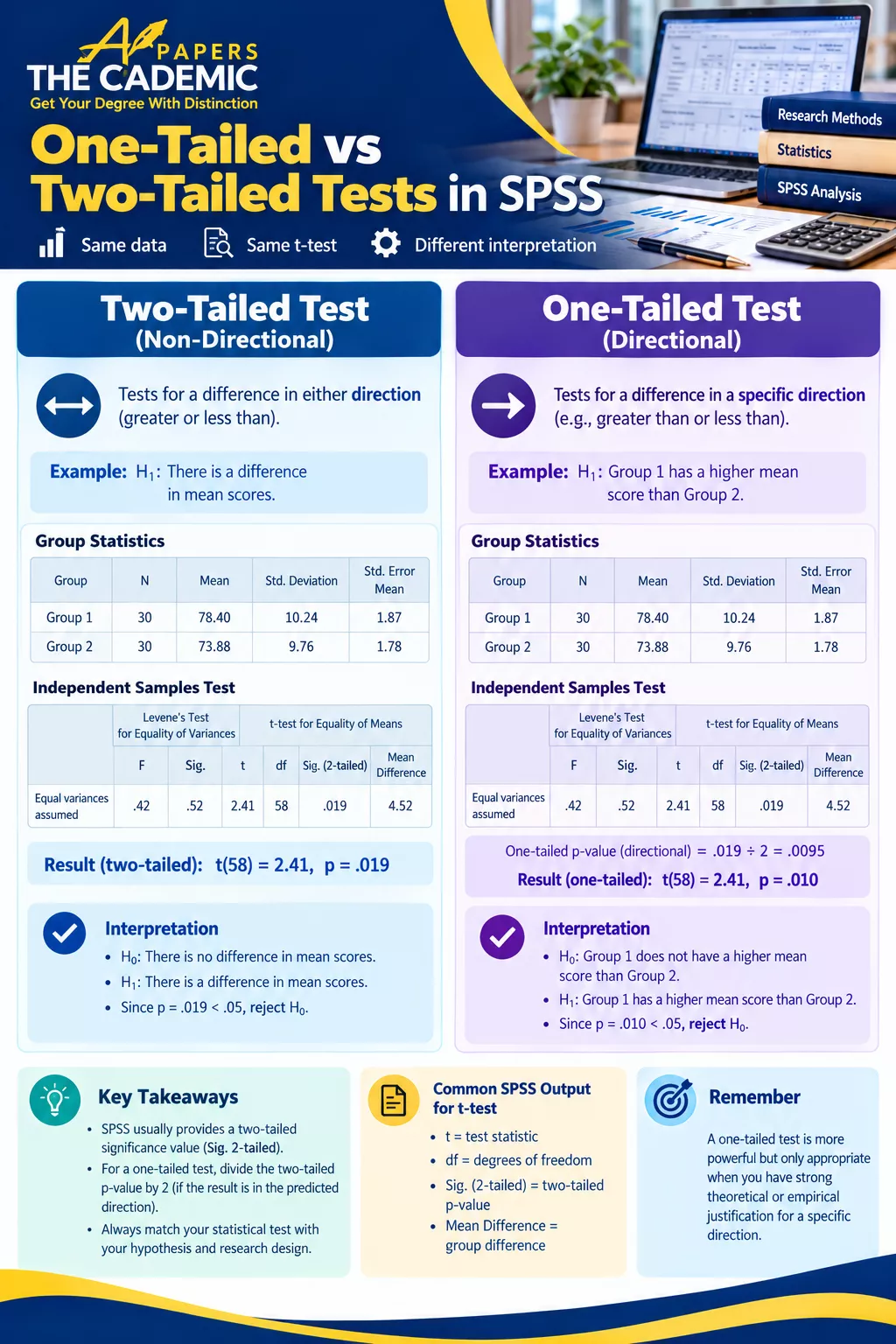
When reporting statistical findings in Chapter 4 (Results) and discussing them in Chapter 5 (Discussion), use precise, conventional academic phrasing. For example,
Hypothesis 1 was supported by the empirical data.
The null hypothesis was rejected at the 𝛼=0.05 significance level.
The analysis failed to reject the null hypothesis; therefore, Hypothesis 2 was not supported.
It is concluded that this guide provides you with complete steps on how to write a research hypothesis. 6 steps were discussed that you must follow when writing a research hypothesis. Begin with a focused question, then read relevant literature or theory, identify measured variables, predict the expected relationship and state hypotheses H0 and H1. You need to clarify that your hypothesis is aligned with your research design, data, and statistical test. You do not use general variables, do not allow too many hypotheses, and do not allow a hypothesis to be “proved” using statistics. After formulating your hypotheses, you need to choose suitable data-analysis techniques and statistical tests. If you are developing your early methodology and need expert guidance on your research design, explore our expert dissertation methodology help service for detailed feedback on structuring questions, variables, and hypotheses.
Have a well-defined research question, read about the topic, identify variables, make predictions about the variables, write H0 and H1, and make sure that the hypothesis is testable.
H0: The study time and exam score are not significantly correlated. H1: Students who study more take higher scores on the exam.
A research question is a general question that you want to explore, while a hypothesis is a detailed, testable prediction of how you think the variables will relate to one another.
Research questions or research objectives are more commonly used in most qualitative studies, as they examine experience, meaning, or process rather than statistical predictions.
It does not prove or disprove; however, researchers collect data to either support or not support a hypothesis to either reject or not reject H0.
There is no set number. Typically, a dissertation contains only a handful of hypotheses, each of which is directly related to the research questions and objectives of the study.
It can question assumptions, propose other explanations, highlight limitations, and suggest further research directions.

If you want to cite this source, you can copy and paste the citation or click the Cite this article button to automatically add the citation to our free Citation Generator.
Mona Nichols (October 12, 2026). How to Write a Research Hypothesis (with Examples) Retrieved October 19, 2026, from https://www.theacademicpapers.co.uk/blog/2026/10/12/how-to-write-research-hypothesis/
 Table of Contents


Share your requirement, expected grade, and an expert will be by your side in no time.
Yes, I want an A+